
A shopper used to type a few keywords into Amazon and scroll a page of results. Increasingly, they ask a question instead. Amazon's AI assistant, Rufus, lets people say things like "what should I look for in a joint supplement" or "which of these is best for a small kitchen," and it answers in a sentence or two, often recommending specific products.
That is a real shift in how discovery works, and it raises an obvious question for sellers: how do you show up well in an answer you cannot see being generated? This guide is a practical, honest take. Nobody outside Amazon knows the exact mechanics, and anyone selling you a "Rufus ranking hack" is guessing. But the direction is clear enough to act on, and the good news is that the work also makes your listing better for human buyers.
Quick answer: how do I optimize my listing for Amazon's AI search?
You cannot control Rufus directly, so optimize the content it reads. Make your listing answer the real questions a shopper would ask about your product, in plain text rather than only inside images, across your title, bullets, description, A+ content, and reviews. Cover who it is for, how it compares, and the objections people raise before buying. The same clarity that helps AI assistants understand your product also helps shoppers convert, so there is no downside to doing it now.
Key takeaways
- Rufus answers shopper questions in natural language, so listings that clearly answer those questions have the advantage.
- You cannot set or buy Rufus placement. You influence it through the quality of the content it reads.
- Put selling points in real text, not only inside images, because text is what AI reliably parses.
- Reviews and community Q&A are part of the raw material, not just social proof.
- Every one of these fixes also lifts human conversion, so this is safe work with no trade-off.
First, what Rufus actually is
Rufus is Amazon's generative AI shopping assistant, built into the Amazon app and website. Instead of returning a page of listings, it holds a short conversation: a shopper asks a question, and Rufus replies with guidance and, often, specific product suggestions.
To do that, it draws on Amazon's product catalog and your listing content, on customer reviews and community questions, and on information from across the web. The practical takeaway is simple. Rufus is a reader. What it can say about your product is limited by what you have made readable, which is why the rest of this guide is about the material you feed it.
How AI shopping changes discovery
Traditional Amazon search rewards keyword relevance and sales velocity. A shopper searches "elderberry gummies," and listings compete for that exact phrase. AI-assisted shopping adds a second path that behaves differently.
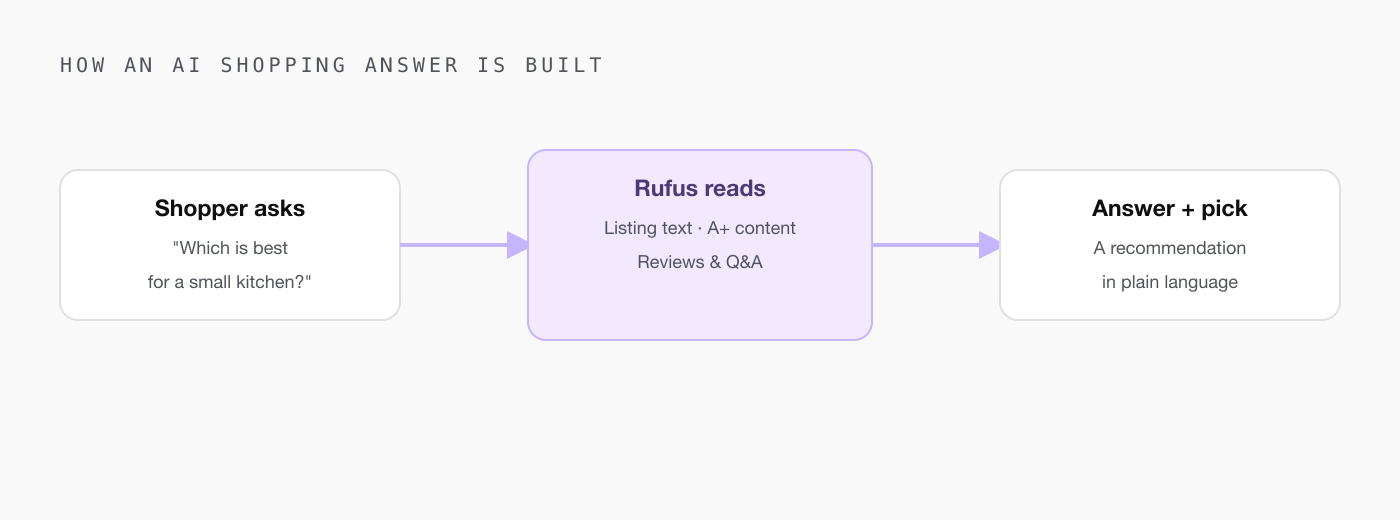
In this second path, the shopper's input is a full question, not a keyword, and the winning listing is the one whose content best answers it. That favors listings that speak to intent and objections, not just ones stuffed with search terms. It does not replace traditional SEO. It sits alongside it, and the same listing has to do well in both.
Step 1: Answer the questions shoppers actually ask
Rufus is built around questions, so the single most useful thing you can do is make sure your listing answers the ones buyers really have.
Write down the ten questions a shopper asks before buying your product. Who is it for. How is it different from the cheaper option. Is it safe for a specific situation. How long does it last. Then make sure each answer appears in plain text on your listing. If your page only lists features and never answers "is this right for me," it gives an AI assistant nothing to work with when a shopper asks exactly that.
Step 2: Put selling points in text, not just images
This is the most common and most costly gap. Great Amazon creative carries key claims inside infographics and A+ modules, which is perfect for human eyes and unreliable for AI.
AI assistants reliably read actual text: your title, bullets, description, the text portions of A+ content, and your reviews. A benefit that lives only inside a graphic may not be read at all. So keep the beautiful infographic, and also state the same point in real text somewhere on the listing. Think of it as writing for two audiences at once, one that sees and one that only reads.
Step 3: Write for intent and comparison, not just keywords
Keyword-stuffed copy reads poorly to humans and gives an AI assistant thin, repetitive material. Rufus is often asked to compare or to match a product to a need, so give it the substance to do that.
Say plainly who the product is best for and who it is not. Name the situations it suits. Where you can do it truthfully and within Amazon's rules, describe how it differs from common alternatives. This is the same benefit-led writing that lifts human conversion, and it happens to be exactly what an assistant needs to recommend you for the right question.
Step 4: Treat reviews and Q&A as source material
Reviews are no longer only social proof for shoppers. They are part of the text an AI assistant reads to understand what your product is actually like and who it works for.
You cannot write your reviews, and you should never try to fake them. What you can do is keep a steady, policy-compliant flow of genuine reviews, and read them for the language real customers use to describe benefits and use cases. Answer questions in the community Q&A section clearly, because those answers are readable content too, and an unanswered question is a gap where an assistant has nothing to draw from.
Step 5: Keep the listing complete and current
AI assistants favor listings that are thorough and consistent, because a complete page gives more to reason from and fewer contradictions to trip over.
Fill in your attributes and structured fields, not just the visible copy, since that structured data helps any system understand your product. Keep claims consistent across the title, bullets, A+ content, and images, so a shopper and an assistant get the same story. A sparse or half-finished listing is a weak input no matter how good your product is.
A Rufus-readiness checklist
Run your top listing through this. If you cannot answer yes to most of it, you have found your next improvements.
Content
- The listing answers, in plain text, the top ten questions a buyer asks before purchasing.
- Every selling point that appears in an image also appears somewhere in real text.
- The copy says clearly who the product is for and who it is not.
Comparison and intent
- The listing addresses how the product compares to common alternatives, truthfully.
- Common objections and use cases are named and answered.
Reviews and Q&A
- There is a steady flow of genuine, recent reviews.
- Community questions are answered clearly, not left blank.
Completeness
- Structured attributes and backend fields are filled in, not just the visible copy.
- Claims are consistent across title, bullets, description, A+ content, and images.
Frequently asked questions
What is Amazon Rufus?
Rufus is Amazon's generative AI shopping assistant, built into the Amazon app and site. Shoppers ask it questions in plain language, like what to look for in a product or which option suits a need, and it answers using Amazon's catalog, your listing content, reviews, community Q&A, and information from around the web.
Can I directly control what Rufus says about my product?
No. There is no Rufus dashboard or ranking setting for sellers, and anyone promising to game it is guessing. What you can control is the raw material Rufus reads: clear, complete, well-structured listing content that answers real buyer questions. Better inputs give you a better chance of being surfaced accurately.
Does Rufus read the text inside my listing images and infographics?
Do not count on it. AI assistants reliably parse actual text, such as your title, bullets, description, A+ content text, and reviews. Text baked into an image may not be read the same way. If a selling point only exists inside a graphic, add it in real text somewhere on the listing too.
Will optimizing for Rufus hurt my normal Amazon SEO?
No, and that is the reassuring part. Writing clear content that answers buyer questions helps human shoppers convert, supports traditional keyword relevance, and gives AI assistants better material to work with. There is no trade-off, which is why it is worth doing even while AI search is still new.
A final word
AI shopping is early, and the exact mechanics will keep changing. What will not change is the underlying lesson: the listings that win in an AI answer are the ones that most clearly and completely answer what a shopper is trying to figure out. That has always been good listing practice. Rufus just raises the reward for doing it well, and the penalty for a thin, image-only page that leaves the reader, human or machine, guessing.