
Nothing sours a good month on Amazon like opening your fee report and finding a storage charge you did not expect. For sellers, storage fees are one of the quietest drains on margin, because they accumulate in the background while your attention is on ads and rankings.
The good news is that storage fees are largely controllable once you understand what drives them. This guide breaks down the fees Amazon actually charges, then gives you a practical playbook to stop overpaying, especially on the aged-inventory surcharge that catches so many sellers off guard.
One note before the numbers. Amazon revises its fees regularly and rates rise sharply in Q4, so treat every figure here as an approximate guide and confirm the current rates in your Seller Central fee schedule before you plan around them.
Quick answer: what are Amazon storage fees and how do I lower them?
Amazon charges a monthly inventory storage fee based on the space your stock occupies, an aged-inventory surcharge on units that sit too long, and for some accounts a low-inventory-level fee. Rates climb steeply in the Q4 peak. You lower them by not overstocking, watching inventory age and sell-through, and clearing slow units through promotions, removals, or liquidation before they cross the surcharge thresholds.
Key takeaways
- Storage cost is driven by two things: how much space your stock takes and how long it sits.
- The aged-inventory surcharge escalates the longer a unit stays, so slow inventory gets more expensive every month.
- Monthly storage rates rise sharply in Q4, which is when overstocking hurts most.
- The cheapest storage fee is the one you never trigger: send inventory in line with real sales velocity.
- Confirm current rates in Seller Central, because Amazon changes them and this guide is directional.
The fees Amazon actually charges
Storage billing is really a few separate charges stacked together. Understanding each one tells you exactly which lever to pull.
Monthly inventory storage fee
This is the baseline charge for the space your inventory occupies, billed per cubic foot and calculated on your average daily volume through the month. Two things drive it: product size and the calendar.
Off-peak (roughly January through September), standard-size items run in the region of under a dollar per cubic foot per month, with oversize lower per cubic foot. In the October to December peak the rate jumps several times higher, because that is when fulfillment-center space is scarcest. The practical lesson is that the same pallet of slow stock costs a fraction in spring and a small fortune in Q4.
The aged-inventory surcharge
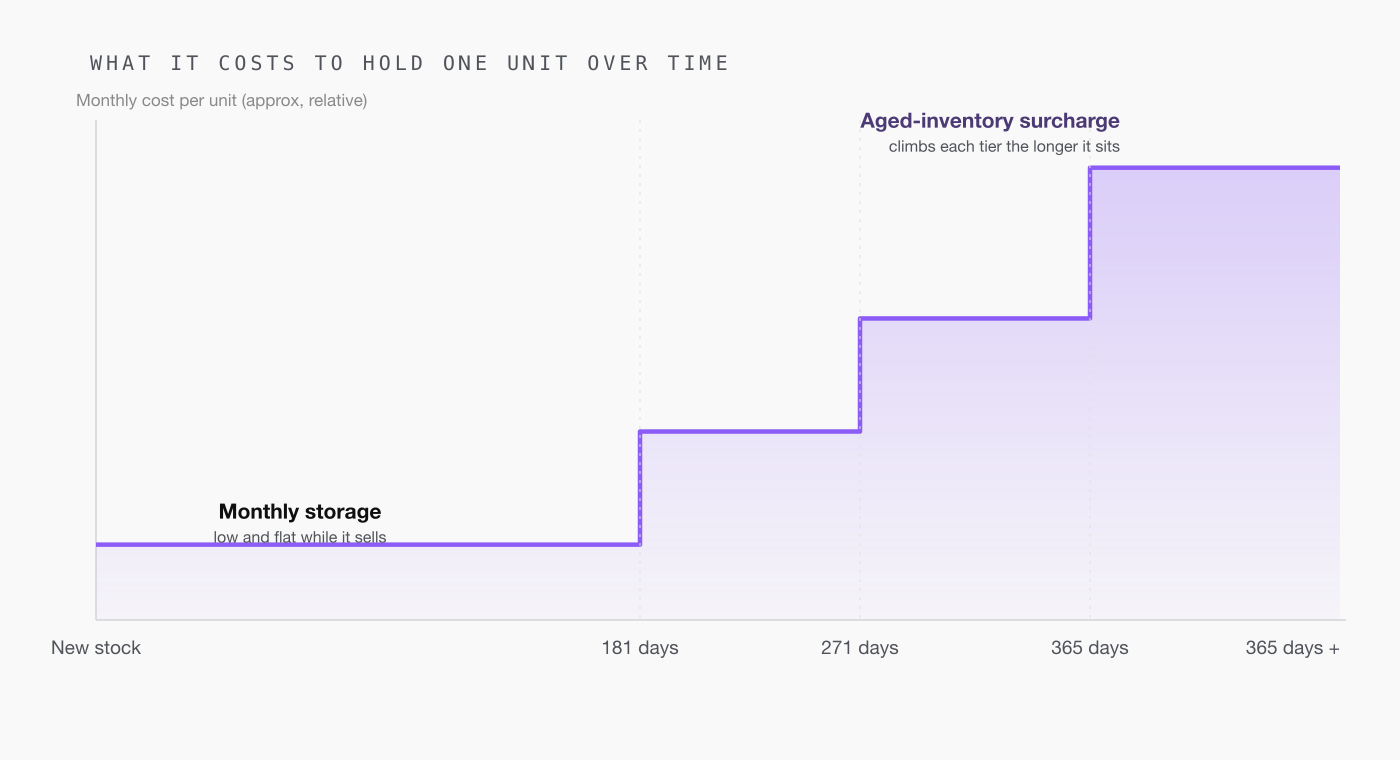
This is the one that surprises people. On top of monthly storage, Amazon adds a surcharge to units that have been in a fulfillment center too long, and it escalates in tiers as the stock ages, commonly starting around the 181-day mark and stepping up through the 365-plus-day tier.
The logic is simple: Amazon does not want its warehouses used as long-term storage, so it makes holding slow inventory progressively painful. A unit that would cost cents to store when fresh can cost multiples of that once it crosses into the older tiers. Aged stock is not a flat problem, it is a compounding one.
The low-inventory-level fee
More recently, Amazon has charged some accounts a fee when a product is kept at consistently low inventory relative to its sales, because thin stock is less efficient for the network to fulfill. It pushes in the opposite direction from the storage fee, which is the real tension of inventory planning: too much stock triggers storage and aged-inventory costs, too little can trigger a low-inventory fee and stockouts. The goal is the healthy middle.
Capacity limits and overage
Amazon also sets capacity limits on how much you can send in, and sending beyond your limit can incur an overage charge. Even when there is no direct overage fee, exceeding what you can sell simply converts into storage and aged-inventory costs later. Capacity is a signal worth respecting, not a ceiling to fight.
How to stop overpaying
Every one of these fees traces back to two decisions: how much you send, and how fast it sells. Here is where to focus.
Do not overstock in the first place
The cheapest storage fee is the one you never trigger. Send inventory in line with genuine sales velocity rather than in large speculative batches. It is tempting to ship six months of stock to save on inbound shipping, but the storage and aged-inventory costs of holding it, especially through Q4, usually erase the saving. Replenish more often in smaller quantities.
Watch inventory age, not just quantity
Total units on hand tells you little. What matters is how old they are. In Seller Central, use the inventory age and estimated storage fee views to see which units are approaching the surcharge tiers, and act before they cross, not after the charge lands. Aged inventory is predictable, which means it is preventable.
Clear slow movers deliberately
When a unit is heading toward the older tiers and will not sell through in time, do the math on holding it versus clearing it. Your options are to drive sell-through with a targeted promotion or price adjustment, create a removal order to pull it out, or liquidate. Paying to remove or discount slow stock often costs less than paying escalating surcharges to keep it sitting.
Plan Q4 inventory with the peak rate in mind
Because storage rates spike in Q4, the cost of being wrong about demand is highest then. Send enough to cover real holiday velocity, not a cushion so large that leftovers sit into the expensive months and then straight into the aged tiers in the new year. A tight, well-forecast Q4 plan protects margin twice.
An aged-inventory audit checklist
Run this once a month. If you cannot answer yes to most of it, that is where your storage bill is leaking.
Know your numbers
- You review inventory age and the estimated storage-fee report in Seller Central monthly, not just when a fee lands.
- You know which SKUs are within 60 days of the next aged-inventory tier.
Act before the thresholds
- Slow units have a clear plan (promote, remove, or liquidate) before they cross a surcharge tier.
- You are not holding more than roughly a quarter's worth of cover on any slow SKU.
Plan around the calendar
- Q4 send-in quantities are based on forecast velocity, not a large just-in-case buffer.
- You replenish fast movers in smaller, more frequent shipments rather than big speculative batches.
Frequently asked questions
What are Amazon FBA storage fees?
They are what Amazon charges to hold your inventory in its fulfillment centers. The main ones are a monthly inventory storage fee based on the space your stock occupies, an aged-inventory surcharge on units that sit too long, and, for some accounts, a low-inventory-level fee. Rates change over time and rise sharply in Q4, so always confirm current numbers in Seller Central.
What is the Amazon aged-inventory surcharge?
It is an extra monthly charge on units that have been stored for a long time, applied in escalating tiers the longer stock sits (commonly starting around 181 days and increasing through the 365-plus-day tier). It exists to push sellers to clear slow-moving inventory rather than use fulfillment centers as long-term storage.
Why are my Amazon storage fees so high in Q4?
Amazon raises the monthly storage rate steeply during the October to December peak, often several times the off-peak rate per cubic foot, because space is scarcest then. Overstocking ahead of Q4 and holding slow sellers through that window is what usually produces a shocking storage bill.
How do I avoid Amazon aged-inventory surcharges?
Watch your sell-through and inventory age, act on aged stock before it crosses the surcharge thresholds, and use removal, liquidation, or promotions to clear slow units. The cheapest fix is not overstocking in the first place, so send inventory in line with real sales velocity rather than in large, speculative batches.
A final word
Storage fees feel like a cost of doing business on Amazon, but most of the bill is a planning problem in disguise. Space and time are the only two drivers, and you control both. Send what you can actually sell, watch how old your stock is getting, and clear the slow movers before Amazon makes you pay to keep them. Do that consistently and the surprise line on your fee report quietly disappears.