
Your rank was stable. You did not touch the listing, the price, or the campaigns. Then the keyword you owned slid from page one to page three, and sessions followed it down.
This is one of the most disorienting problems on Amazon, because the instinct is to look for the change you made. There usually is not one. Rank is not a score you hold. It is a position in a race, and you can lose it by standing still.
This guide is a diagnostic playbook. Work through it in order, because the checks are arranged from cheapest to most expensive, and the early ones eliminate the causes people usually miss.
Quick answer: why is my Amazon rank dropping with no changes?
Organic rank falls when your sales velocity drops relative to competitors on the same keyword. That can happen without you changing anything: a competitor increased ad spend, a stockout interrupted your velocity, your conversion rate slipped, your rating fell, or someone silently edited your listing content. Diagnose in that order, confirm the cause with data before acting, then rebuild velocity on the exact keywords you lost.
Key takeaways
- Amazon ranks you relative to competitors, so a competitor's move can cost you rank while your listing sits untouched.
- Velocity is the engine. Anything that interrupts sales velocity, including a short stockout, starts a decay loop that feeds itself.
- Check for a silent content or catalog change before you assume the market moved.
- Recovery means rebuilding velocity on the specific keywords you lost, not on the listing in general.
Understand the decay loop before you diagnose
Rank problems rarely stay small, and the reason matters for how urgently you act.
When velocity drops for any reason, Amazon shows your listing less. Fewer impressions means fewer clicks, which means fewer sales, which lowers velocity again. The system reinforces its own conclusion. This is why a three-day stockout can cost you six weeks of position, and why waiting to see if it recovers on its own is usually the most expensive choice available.
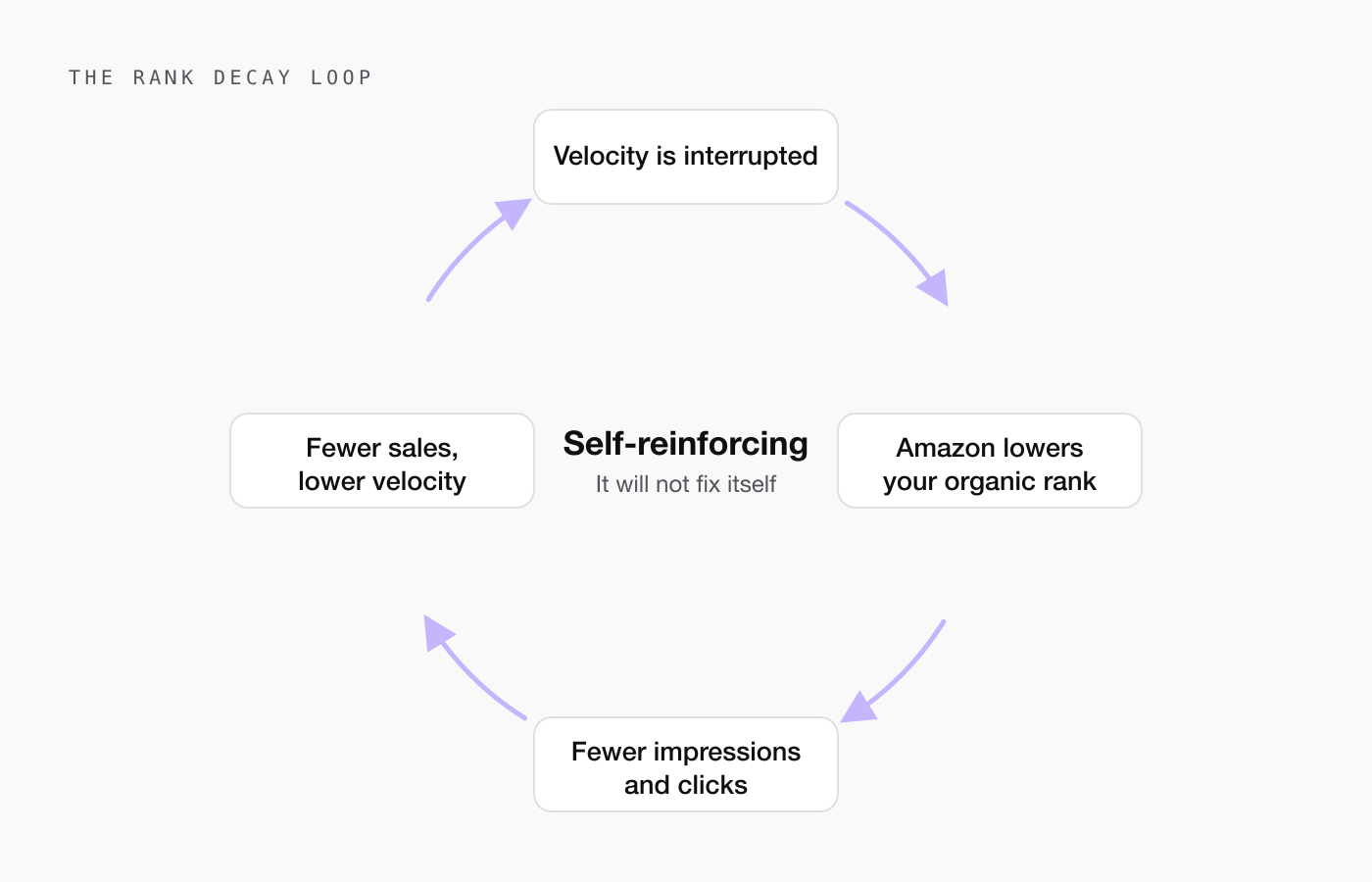
The practical consequence: you are not trying to find out what broke. You are trying to find what interrupted velocity first, before the loop obscures it.
Step 1: Confirm it is actually a rank drop
Before you diagnose a cause, make sure you have the right symptom. Sessions can fall for reasons that have nothing to do with organic position.
Open Search Query Performance in Brand Analytics and look at your impression share and click share on the keywords that matter. If impressions fell while your share of them held steady, the whole category got quieter and you are looking at seasonality, not a rank loss. If your impression share fell while total category impressions held, you genuinely lost position.
Do this first. A surprising number of rank emergencies are demand curves.
Step 2: Rule out a stockout or a Buy Box loss
These are the two causes that produce the sharpest drops and the fastest recoveries, so eliminate them before you go further.
Check your inventory history for any period at zero, including brief ones you may have forgotten. Then check Buy Box percentage over the same window. Losing the Buy Box, whether to a competing offer, a pricing error, or a suppressed variation, stops your velocity as completely as running out of stock does. Both start the decay loop.
If you find one, you have your answer. Skip ahead to the recovery section.
Step 3: Look for a listing change you did not make
This is the check almost nobody runs, and it is the one that most often explains a mysterious slide.
Amazon listings can be edited without your involvement. Other contributors to the catalog, automated category data updates, and brand registry changes can rewrite your title, reorder bullets, or drop backend search terms. If a keyword disappeared from your indexed content, your relevance for it disappeared with it.
Compare the live listing against your own copy of the content, word for word. Check that you still index for your primary keywords by searching the exact phrase plus your ASIN. If the ASIN does not return, you are not indexed, and no amount of ad spend will fix a relevance problem.
Step 4: Check whether conversion slipped before rank did
Rank follows conversion, so a conversion decline usually precedes a rank decline by a week or two. That lag is a gift, because it tells you which one caused the other.
Pull unit session percentage for the affected products and line it up against the date your rank started falling. If conversion dropped first, the market did not move. Something on your page stopped persuading people, and the rank loss is a downstream symptom. If conversion held steady while rank fell, the cause is external and you should keep reading.
Step 5: Check your rating and recent reviews
A rating that crosses below roughly four stars changes shopper behavior sharply, and recent negative reviews carry more weight than old ones.
Look at whether a cluster of one and two star reviews landed just before the slide. A rating drop hurts twice: it lowers conversion, and the lowered conversion lowers rank. Read the reviews as a group and look for a repeated complaint, because a pattern points at a product or expectation problem that image polish will not solve.
Step 6: Look at what your competitors did
If your listing is unchanged, your content is intact, and your conversion held, then somebody else moved. This is the most common answer for a slow, steady slide rather than a sudden cliff.
Check the top results for your keyword and compare them against what you remember. Look for new entrants, price cuts, a competitor who suddenly appears in every sponsored slot, coupons and badges you do not have, and review counts climbing faster than yours. A competitor who doubled ad spend buys velocity, and velocity buys organic rank. Your position fell because theirs rose.
You cannot undo a competitor's spend. You can decide whether the keyword is worth contesting, which is a business question rather than a technical one.
Step 7: Check price and offer competitiveness
Price interacts with rank through conversion, and it moves without you when competitors reprice.
Compare your price against the current top results, not against what they charged last quarter. Also check whether you lost a coupon, a Subscribe and Save discount, or a badge like Amazon's Choice, because each of those changes conversion, and conversion changes rank. Losing a badge is invisible in your own reporting and obvious to shoppers.
The recovery sequence
Once you know the cause, recovery follows the same shape almost every time. Fix the root cause first. Rebuilding velocity on top of an unresolved problem just buys expensive traffic for a page that still loses.
Then rebuild velocity deliberately, on the exact keywords you lost rather than the listing in general. Target those terms with paid placements to restore click and conversion signals where the rank fell, keep inventory buffered so a second interruption does not restart the loop, and hold the effort long enough to matter. Velocity is measured over time, so a two-week push tells Amazon something a two-day push does not.
Expect two to four weeks to recover from a clean, short interruption. Expect longer if the cause was a rating drop or a content problem, because you are rebuilding the reason people convert before you can rebuild the velocity that follows.
Track the specific keyword position, not overall sessions. Sessions will lie to you during recovery, because paid traffic masks whether the organic position actually came back.
Frequently asked questions
Why is my Amazon listing losing rank when I changed nothing?
Amazon ranks you relative to competitors, not against a fixed standard. If a competitor raises ad spend, cuts price, or wins reviews faster than you, your rank falls even though your listing is identical. Rank is a moving position in a race, not a score you keep.
How long does it take to recover organic rank on Amazon?
For a short stockout or a brief velocity dip, recovery usually takes two to four weeks of restored sales velocity. A deeper slide caused by a rating drop or a lost Buy Box takes longer, because you have to fix the underlying cause before velocity can rebuild.
Does going out of stock permanently hurt Amazon ranking?
Not permanently, but it does real damage. Rank decays while you have no sales velocity, and you restart behind competitors who kept selling. Short stockouts of a few days recover quickly. Stockouts of several weeks often require paid traffic to rebuild momentum.
Can Amazon change my listing without telling me?
Yes. Other contributors, brand catalog data, and automated category updates can overwrite titles, bullets, and backend terms. Check the listing against your own source of truth regularly, because a silent content change can drop keyword relevance overnight.
A final word
The hardest part of a rank slide is accepting that the cause may not be yours. A listing you never touched can lose position because the race got faster around it. The sellers who recover quickly are not the ones who react hardest. They are the ones who find what interrupted velocity first, fix that, and then rebuild in the exact place they lost it.