
Few emails land harder than the one telling you your Amazon account has been deactivated. Your listings go dark, your sales stop, and your funds are held, all at once. It is stressful, and the instinct to fire off an immediate, emotional appeal is completely natural.
That instinct is also the most common reason appeals fail. Reinstatement is not about convincing Amazon you are sorry. It is about showing them, clearly and factually, that you understand what went wrong and have already fixed it. This guide walks you through that process in order, and gives you a Plan of Action template you can adapt to your own case.
One honest note before we start. No guide, and no agency, can promise reinstatement. Amazon makes the final decision, and some cases are harder than others. What you can control is the quality of your appeal, and a well-built Plan of Action gives you the best chance you can have.
Quick answer: how do I get my Amazon account reinstated?
To reinstate a suspended Amazon account, first find the exact reason in the notification and your Account Health dashboard, then submit a Plan of Action that states the root cause of the problem, the corrective actions you have already taken, and the preventive measures that stop it recurring. Keep it factual and specific, attach evidence such as invoices or corrected listings, and submit once through the correct channel rather than sending repeated appeals. If the first appeal is rejected, refine it based on the response before escalating.
Key takeaways
- Do not appeal in the first hour. Read the actual reason first, because appealing the wrong problem wastes your best attempt.
- A Plan of Action has three parts: root cause, immediate corrective actions, and preventive measures. Missing any one is the most common reason for rejection.
- Be factual, not emotional. Amazon reviewers want evidence and specifics, not apologies.
- Submit once, cleanly. Repeated or duplicate appeals can slow your case down.
- Held funds are usually held, not lost. Reinstatement is the reliable route back to them.
Step 1: Do not panic, and do not appeal yet
The single most expensive mistake is a rushed appeal sent before you understand the problem. Your first appeal gets the most careful attention, so spending it on a guess is costly.
Take a breath and resist the urge to reply to the suspension email with an explanation. You have not lost your business. Deactivation is usually a paused state you can appeal, not a permanent ban. The goal for the first hour is to gather information, not to argue your case.
Step 2: Find the real reason for the suspension
You cannot fix what you have not correctly identified, and Amazon's notification is not always as specific as you need.
Start with the deactivation email, then open Account Health in Seller Central and read every flagged item. Look for the specific policy referenced, whether it is a performance metric like Order Defect Rate, an authenticity or intellectual property complaint, a restricted product listing, or a Section 3 concern about account activity. Note the exact ASINs, orders, or policies named. If several issues appear, they may be linked, so map them all before you write anything.
If the reason genuinely is not clear from the dashboard, that lack of clarity itself shapes your appeal, and we will handle it in the template below.
Step 3: Gather your evidence before you write
A Plan of Action is only as strong as the proof behind it. Assemble your evidence before drafting, because it determines what you can honestly claim.
Depending on the issue, this might mean supplier invoices that prove authenticity, corrected listing screenshots, a letter of authorization from a brand, shipping or tracking records, or documentation of a process you have changed. Gather the real documents now. Never fabricate or alter anything, because Amazon does verify, and a falsified document turns a recoverable suspension into a permanent one.
Step 4: Write the Plan of Action
This is the core of your appeal. A Plan of Action, or PoA, is the document Amazon uses to decide whether to reinstate you. Every strong PoA answers three questions in order: what went wrong, what you have already done about it, and how you will prevent it from happening again.
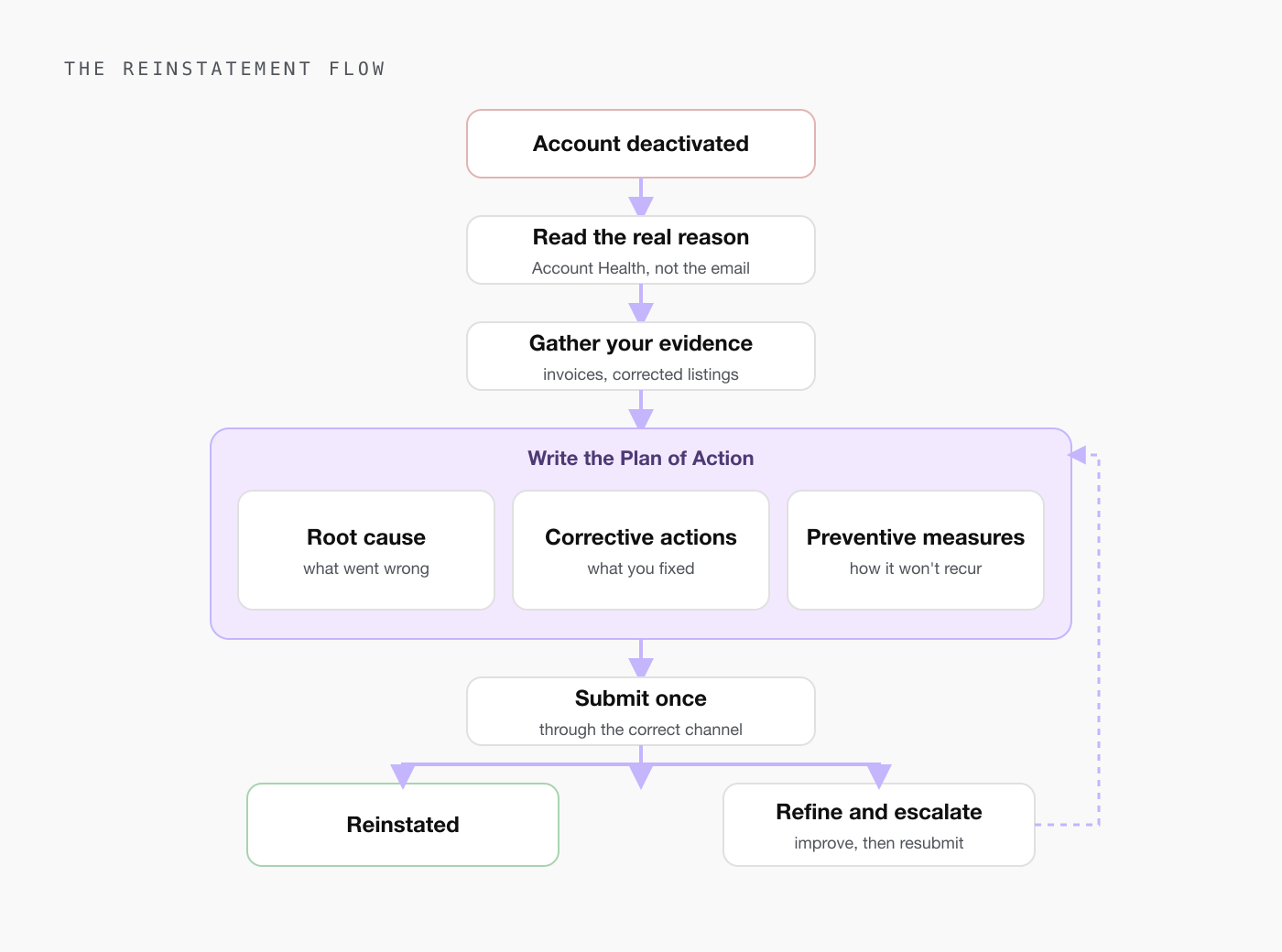
Keep the tone factual and professional. Take responsibility where you genuinely are responsible, but do not grovel, over-explain, or make emotional appeals about the impact on your business. Reviewers read hundreds of these, and specificity is what stands out.
A Plan of Action template you can adapt
Use this as a starting structure, then replace every bracketed section with the specifics of your own case. Do not send it as-is. A generic PoA is easy to spot and easy to reject.
Plan of Action: [Your account or ASIN]
Root cause We have reviewed our account and identified that the issue was caused by [state the specific, factual reason: e.g. an inauthentic complaint on ASIN X because we could not initially provide a valid supplier invoice / a spike in late shipments during a supplier delay / a listing that violated policy Y]. We understand this affected [the specific metric or policy], and we take responsibility for [the part that is genuinely ours].
Immediate corrective actions (already completed) To resolve the issue, we have already: [list concrete, completed actions, e.g. removed the affected ASIN, obtained and attached valid invoices from our authorized supplier, corrected the listing to comply with policy Y, refunded affected customers]. Supporting evidence is attached: [list documents].
Preventive measures (to stop recurrence) To prevent this from happening again, we have implemented: [list specific, verifiable process changes, e.g. a pre-listing compliance check against policy Y, a new inventory buffer to prevent stockouts, a supplier vetting step requiring documentation before purchase, weekly Account Health monitoring]. These changes took effect on [date] and are now part of our standard operating procedure.
We respectfully request reinstatement and are happy to provide any further documentation required.
The three headings matter. Reviewers look for all three, and an appeal that explains the cause but skips the preventive measures, or lists fixes without owning the root cause, is a common rejection.
Step 5: Submit once, through the right channel
How you submit matters almost as much as what you submit. Send your appeal through the path Amazon specifies in the notification, usually the Reactivate your account or appeal button in Account Health, not by replying to the email or opening unrelated cases.
Then wait. Submitting the same appeal repeatedly, or opening multiple cases, can push your case backward or get it treated as duplicate. Give the review the time it needs. If Amazon asks a clarifying question, answer it directly and only what was asked.
Step 6: If the first appeal is rejected, refine before you escalate
A rejection is not the end, but sending the same document again will not change the outcome. Read the response carefully, because it usually signals what was missing.
Adjust the specific weakness, whether that is stronger evidence, a clearer root cause, or more concrete preventive measures, and resubmit an improved version. If repeated, genuine attempts stall, escalation paths exist, including a direct appeal to Amazon's executive team, but treat those as later steps after a well-built PoA, not as a first move. This is also the point where many sellers bring in experienced help, particularly if the account represents serious revenue.
How to make sure this never happens again
The best reinstatement is the one you never need. Once you are back, the same three-part thinking that reinstates an account also protects it.
Monitor your Account Health dashboard weekly rather than waiting for an email, keep documentation for every product so authenticity complaints are easy to answer, hold an inventory buffer so a stockout never spikes your defect metrics, and check new listings against policy before they go live. Account health is not a one-time fix. It is a habit, and it is far cheaper than a suspension.
Frequently asked questions
How long does an Amazon account reinstatement take?
It varies widely. A clear, well-documented Plan of Action for a straightforward issue is often reviewed within a few days, but complex cases, multiple violations, or appeals that need escalation can take several weeks. Amazon does not publish a guaranteed timeline, and submitting repeated or incomplete appeals usually slows the process down rather than speeding it up.
What is a Plan of Action on Amazon?
A Plan of Action, or PoA, is the written appeal Amazon asks for to reinstate a suspended account or listing. A strong PoA has three parts: the root cause of the issue, the immediate corrective actions you have already taken, and the preventive measures that stop it from happening again. It should be factual and specific, not emotional or apologetic.
Can I still get paid if my Amazon account is suspended?
Suspended funds are typically held, not forfeited. Amazon generally holds disbursements for a period to cover potential refunds or claims, and releases the balance after that window provided there are no outstanding chargebacks or A-to-z claims. Reinstating the account is the most reliable path to accessing held funds normally.
What is the difference between a suspension, a deactivation, and a ban?
In practice Amazon uses deactivation and suspension to mean an account or listing that is paused but appealable, which is the situation most sellers can recover from with a Plan of Action. A permanent ban or enforcement means Amazon has decided not to accept further appeals, which is rarer and usually follows repeated violations or serious policy breaches.
Should I hire someone to write my Amazon appeal?
For a first, straightforward suspension with a clear cause, many sellers can write an effective Plan of Action themselves using the right structure. Professional help is worth considering when the reason is unclear, when a first appeal has already been rejected, or when the account represents significant revenue and you cannot afford a drawn-out process.
A final word
A suspension feels like the end of your Amazon business, but for most sellers it is a recoverable setback, not a closure. The sellers who come back fastest are not the ones who appeal hardest in the first hour. They are the ones who slow down, find the real cause, prove they have fixed it, and ask for reinstatement in the clear, factual language Amazon is looking for.